A Warm Hearth for a Troubled Church
|
||||||||
 A Warm Hearth For a Troubled Church, by Leonie Caldecott A Warm Hearth For a Troubled Church, by Leonie Caldecott
Last
Sunday, Vincent Nichols, the Archbishop of Birmingham, sent a pastoral
letter to all the parishes in his diocese. The letter dealt with the
Nolan Report and the measures that the diocese was taking to implement
it. Yet the archbishop was rightly concerned to situate this matter in
its wider spiritual context. He referred to the gospel of the day, in
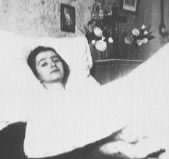
which Jesus sits with tax collectors and sinners. ”As we come to know the love that Christ offers to us, so too, step by step, we come to know the freedom of heart that he alone can give. Then we will find ourselves filled with a surprising and rare gift: the gift of mercy for others who are marked with the wounds of sin.” It seems to be an apposite moment to look again at initiatives in the Church which have sought to foster exactly this quality. One of these is the Foyers de Charite, founded in 1936 by Marthe Robin and her spiritual director, Pere Georges Finet. I described the mission of Marthe Robin in these pages last year, but for those of you who missed it, suffice it to say that like St. Therese of Lisieux and Cardinal Newman, Marthe was a prophetic soul who, decades before the Second Vatican Council, foresaw the need for an active and effective lay apostolate in the coming century, an apostolate which would respond specifically to the social upheaval, confusion and wounds of the increasingly godless era in which we find ourselves. The
response of Marthe and Father Finet was to set up a “foyer” -
literally, a “hearth” or a place of welcome – where people could come
on retreat and be filled with the goodness and love of God, mediated to
them through the sacraments, prayer (particularly in front of the
Blessed Sacrament) and a gentle, very Marian and motherly witness by
those who had turned their lives over to God. The revolutionary thing
about the Foyers, given the period in which they were founded, is the
collaboration between the lay people running the Foyer, and the priest
who gives himself over, with the full and glad assent of his bishop, to
be the spiritual Father of the community. The
initial Foyer at Chateauneuf de Galaure, where Marthe lived, gave rise
to other such ‘centres of light, love and charity’, first in France,
and eventually all over the world. At present there are more than sixty
Foyers, approved by the Pontifical Council for the Laity (which in 2000
gave them official status as a private association of the faithful
of an international character’). Apart from countries in both Western
and Eastern Europe, many of these are in Africa and Asia, three are in
Canada and one in the USA. But there are as yet no Foyers in the United
Kingdom. Why should this be? Speaking
as a Catholic convert of nearly twenty years standing, who has had
extensive contact with Catholics in a number of places around the
world, I feel it is, sadly, symptomatic of the ills that dog the Church
in this country. I find myself constantly in the middle of a sort of
ideological struggle between seemingly rigid stances in the Church, be
they of the ‘right’ or of the ‘left’, which prevent us coming together
and working together as a community. Recently
I was mocked by a young man half my age because of what he assumed were
my liturgical preferences. A few days later I found myself being
patronised by various conservative catholics who couldn’t quite believe
that I could be trusted to produce work which would be doctrinally
sound. Neither of these incidents should have mattered to me, but they
did. They hurt. They made me feel that I did not belong in either camp.
I wonder how many other catholics are feeling the same way, and if so,
how many non-catholics are put off entering the ‘one fold of the
Redeemer’ by this uncharitable sniping, smugness or worse. Sexual
molestation is not the only form of abuse we can deal out. There
is a crying need for the sort of holiness, among both clergy and laity,
which mitigates these natural manifestations of original sin with a
burning charity that takes the example of Christ himself as its source.
I can’t help wondering if the model of the Foyers might not provide at
least a partial response to this need? Reading and hearing the witness
of those who have attended Foyer retreats in other countries, it seems
to me that it would be helpful to have such places in this country.
Places where anyone and everyone is welcome to come and find
refreshment and peace, where there is no ‘organisation’ behind the
scenes which one will be pressured to join, there is no ‘agenda’ other
than the Gospel, no ‘affiliation’ to any body in the Church other than
the Church herself. We need places where clergy and laity live
alongside of one another in sincere fraternal charity, where the one
can vouch for the other on the basis of a lengthy period in which they
have lived out their parallel vocations in the service of Christ. A
group of people who are interested in seeing a Foyer of Charity founded
in this country get together once a year for a five-day retreat. This
year’s retreat will be from 9th to 14th September at the Carmelite
Priory in Boar’s Hill, Oxford, and will be led by Father Ian Ker, the
great Newman scholar who has also written about many of the lay
movements. May it prove to be a time of genuine refreshment, when as
Archishop Nichols put it last Sunday: “We know why we are here,
gathered together in the Church. We are here because we acknowledge how
fickle our love for God can be; we know our need of God’s love and
mercy.” This article appeared in the Catholic Herald of 16 June 2002 |