The First Foyer of Charity
 On February 10th 1936 a young priest in his thirties named
Georges Finet
drove down from Lyon, where he was Director of Education for the
diocese, to the village of Châteauneuf-de-Galaure in the Drôme
foothills to visit a lady he had not met before. On February 10th 1936 a young priest in his thirties named
Georges Finet
drove down from Lyon, where he was Director of Education for the
diocese, to the village of Châteauneuf-de-Galaure in the Drôme
foothills to visit a lady he had not met before.
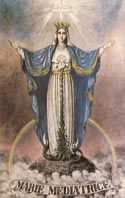
He
carried in his car a hand-coloured picture of Mary Mediatrix of All
Graces, which a mutual friend had asked him to deliver to her. Later he
was to say "I thought I was taking Our Lady's picture to Marthe, but it
was She who was bringing me!"
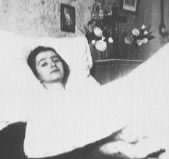
Marthe
lived with her parents in a small farmhouse a mile from the village.
Born in 1902, the youngest of five children, she had been bedridden
since 1928, and from 1929 more of less paralysed.
Already
she had a reputation for living in the closest possible mystical union
with Christ and his Mother, and in October 1930 she had been marked
with the stigmata of his Passion, and every Friday relived his
sufferings on the Cross.
This
meeting was to prove providential, for it led to a partnership between
Marthe and Père Finet which would only be broken by her death in 1981,
by which time there would be some sixty Foyers in five continents.
 In
the course of three hours of conversation Marthe convinced the Abbé
Finet that his vocation lay in helping her. For the first hour they
spoke of the Blessed Virgin and her role in the Church. Finet, who gave
Marian conferences on the teaching of St. Louis Grignion de Montfort,
was astonished at the depth of her insights. In
the course of three hours of conversation Marthe convinced the Abbé
Finet that his vocation lay in helping her. For the first hour they
spoke of the Blessed Virgin and her role in the Church. Finet, who gave
Marian conferences on the teaching of St. Louis Grignion de Montfort,
was astonished at the depth of her insights.
At
three o'clock she began to talk of the great events which were soon to
occur in the world, some very painful (World War II?), others rich in
graces (Vatican II?). She announced "a new Pentecost of Love" which
would be preceded by a renewal of the Church.
This
renewal would occur by means of the apostolate of the laity. "Lay
people are going to have a very important role to play. They will be
formed in communities, notably in Foyers of Light, Charity and Love."
Thus she anticipated the Second Vatican Council, and the call to
renewal by the next three popes.
Père Finet asked her to define a Foyer:
"It
will be something quite new in the Church. It will consist of
consecrated lay persons, but will not be a religious order. A Foyer
will be a great family, with a priest at its head and Our Lady as its
Mother. The teaching that will be given during retreats will be lived
by the community as a witness to its unity and prayer.
The
Foyers will radiate light throughout the entire world. They will be an
answer from the Heart of Christ to the world after the material defeat
of people and their satanic errors." She named communism and secularism
and Freemasonry amongst these errors. There would be an intervention by
Our Lady, she said.
At 4 o'clock Marthe turned to the Abbé Finet and said, "Monsieur l'Abbé, I have a request to make to you, on behalf of God."
"What is that, Mademoiselle?"
"It is you who must come here to Châteauneuf and found the first Foyer of Charity."
"I, Mademoiselle? But I am not in this diocese. I am from Lyon!"
"What does that matter, since God wills it!"
"Ah! I beg your pardon ... I hadn't thought of it like that! But what would I do?"
"Many things. Chiefly you would preach retreats."
"But I do not know how."
"You will learn!"
"Yes ... I suppose three day retreats would be a good thing."
"No. In three days one doesn't change a soul. The Blessed Virgin asks for five whole days."
"I see! And to whom will these retreats be given?"
"To begin with to ladies and older girls."
"And what shall we do during the retreats? Workshops? Discussion groups?"
"No! The Blessed Virgin wants complete silence."
"You think I shall be able to keep ladies and girls in silence for five days?"
"Yes, since that is what Our Lady asks for."
"Ah! I'm sorry ... I hadn't thought of that! But how shall we publicize these retreats?"
"The Blessed Virgin will see to that. Jesus will give extraordinary graces. You won't need a lot of publicity!"
"But where will these retreats take place?"
"In the girls school."
"But we shall need beds ... and a kitchen. Who will take on this work?"
"You!"
"But with what money?"
"Don't worry ... the Blessed Virgin will see to it!"
"When should the first retreat happen?"
"On Monday the 7th of September ... it will last until the afternoon of Sunday the 13th."
"I can't refuse; but I shall have to ask permission from my superiors.
''Of course! You must remain under obedience."
Abbé
Finet's superior, Mgr. Bornet agreed to let him go. So did the
Vicar-general of Lyon. Finally his spiritual director, a professor of
theology at the university, was enthusiastic for the idea. He had
already met Marthe.
Thus
the first retreat was conducted for thirty-three persons (all women),
several of whom were to become permanent members of this original
Foyer. Today there is room for 200 retreatants at Châteauneuf, besides
a school for girls and another in the next village for boys and of
course a growing community.
Fifteen
other Foyers have been established in France, and more than sixty
worldwide in forty countries. Only the Holy Spirit could have created
such a phenomenon. The members do not wear a uniform or take religious
vows. They make a "commitment"; having entered, few leave.
Marthe
Robin, whose cause is well advanced in Rome, would appear to be for the
second half of this century what St. Thérèse was for the first half.
And indeed the two women are closely linked. Whereas Thérèse died aged
24 and became known through her autobiography, Marthe lived to be 79
(she died in 1981) of which the greater part was spent entirely
immobilized in a small room in her parents' house.
Mystically
united to Christ and his Mother, she was visited by most of the
retreatants who came to Châteauneuf over a period of fifty years. It
has been estimated that she may have met a hundred thousand people;
each one waited in the little kitchen and was allowed ten minutes with
Marthe in her darkened room. She showed a keen interest in the affairs
of each visitor, gave sound advice, and always finished by praying with
him or her.
She
had extraordinary insight into those who sought her advice, and all
left her the better for their visit. A number of growing communities
originating in France, such as the Congregation of Saint John and the
Community of the Beatitudes, owe their foundations partly to her
support.
She left
a large collection of prayers, meditations and observations (but being
paralysed she could not actually write herself), which are gradually
being published, and a large number of books have been written about
her. She is constantly quoted in the Foyers.
As
yet there is practically nothing in English, and we await the
foundation of the first Foyer in the United Kingdom. Perhaps her most
striking spiritual document was the Act of Consecration made in 1925 at
the age of 23. In this masterpiece of spiritual thought the word "love"
appears twenty-two times, but "justice" not once.
From
then on she was consecrated through Mary to Jesus to be a living
sacrifice to God. The first full biography of Marthe by Raymond Peyret
(who never met her) was entitled "Take my life Lord" and subtitled 'The
long Mass of Marthe Robin'. She never attended Mass after 1928, yet her
whole life was like a mass, a perfect oblation of thanksgiving, united
to the sacrifice of Christ on the Cross, inspired by love.
"One
can only make people love to the extent that one possesses it, just as
one can only radiate light if one carries within oneself the truth
which is light." Marthe Robin, 16.2.1930.
Martin Blake, June 1998
|