The Spirituality of Marthe Robin
|
||||||||
 The Spirituality of Marthe Robin The Spirituality of Marthe RobinEveryone knows something of St Thérèse of Lisieux, the centenary of whose death fell a few years ago. Less known as yet, at least outside the Francophone world, is another outstanding French mystic named Marthe Robin, who lived from 1902 to 1981. One
of the more hopeful outcomes of the Second Vatican Council—which was
launched with such high hopes of a 'renewal of the Church' in the
sixties, and then led to such disappointment in the ensuing decades—was
the formation of new communities, some clerical and some lay. The
earliest of these, starting in 1936—nearly three decades before the
Council—was the community founded by Marthe Robin and Père Georges
Finet at Châteauneuf de-Galaure, known as the Foyer de Charity. Marthe Robin was the youngest child of a small farmer, who from an early age suffered from poor health; in her twenties she became progressively more handicapped, until by 1930 she was quite paralyzed. At the age of twenty-three she had consecrated herself to Jesus through Mary, following the way suggested in the 18th Century by St Louis-Marie Grignion de Montfort, at whose tomb the Holy Father prayed on the first day of his visit to France in September 1996. She
would have liked to have entered Carmel to share the life of her
special friend Saint Thérèse of Lisieux, for whom she had a marked
devotion. But Jesus had other designs for Marthe. Living
in a not particularly religious area of France, she had grown up with
an unusually developed sense of God, and she practised an intense
prayer life. With growing handicap, she further consecrated her life to
the service of God in a remarkable document written in 1925, at the
time of the canonization of Saint Thérèse. It may be said that Marthe's
spirituality was in essence that of the 'Little Way', and pictures of
the Little Flower are prominent in all the Foyers today. Marthe's particular vocation was to suffer with Jesus. "I have seen Him moving across the world, laden with his Cross, searching for souls to bear it with Him; but they all ran away at his approach ... so once more I offered myself." Three times in 1926 Saint Thérèse appeared to her mystically, entrusting to her the continuation of her mission. Of this Marthe said: "Of
all the forms of the apostolate, that of good works, that of prayer,
that of example, that of suffering, this last apostolate is worth the
most; and prayer, like good works, only acquires its fruitfulness in
sacrifice." At the end of September 1930 Jesus appeared to Marthe and asked her: "Do you want to be like me?" A few days later He marked her body with the marks of his Passion, in her hands, feet, side, and brow. With St Paul she could now say: "With Christ I am fixed to the Cross." (Gal 2) The following Friday she began to relive the Passion of her Lord: this was to happen every week until her death in 1981. Her
only food was the Eucharist which Père Faure, her parish priest,
brought her weekly; nor did she ever sleep again. The first fruit of
this extraordinary life was the founding of a school for girls in the
local chateau, acquired at her request. It opened with three girls;
today there are four hundred: Marthe always had a keen sense of the
importance of children, and they loved her.
"Its
creation will be a refuge for people in great human distress who will
come seeking consolation and hope; within the shelter of its walls will
be the clear sign of my Will and the moving appeal of my Heart to
innumerable sinners, who will come from every part of the world, drawn
by Me and my Mother, in search of Light and healing of their ills in my
divine forgiveness. I want it to be a Foyer radiant with Light, Charity
and Love." The Word of God would be preached there in fundamental teaching given during
five day retreats in silence,
by a priest who would be the Father of a community of baptised lay
people, living together as a family with Mary as their Mother. "I want
all the members of the Foyers to be saints." It was on February 10th 1936 that the
famous meeting between Abbé Georges Finet and Marthe took place.
This marked the beginning of the first Foyer, watched over by Mary the
Mediatrix of All Graces, whose picture the Abbé Finet brought her from
Lyon. link The first retreat took place in the chateau in September, and the second between Christmas and the New Year, which has become traditional in all the Foyers. Jesus had said to Marthe: "The
priest whom I shall send you will not be able to do anything without
you, nor far from you. I want you both to be united with me for the
Mission which I shall entrust to you, for all the souls I want to give
you, for the glory of my name." It was the beginning of a new lay
apostolate, which Vatican II was to stress in a special way. The purpose of a Foyer is to have a lay community or family living in company with a priest who will receive retreatants for five day silent retreats. This, Jesus had told Marthe, was to be an entirely new work for his Glory and would herald a 'new Pentecost of love' in the Church. Imagine Marthe's surprise when these selfsame words were used by Pope John XXIII before the opening of the Second Vatican Council.
Indeed the Foyers may be said to have anticipated the reforms of that
council, and they have been instrumental in applying them on an
ever-increasing scale. To become a member of a Foyer is to embrace a
new form of religious life, and it gives meaning to the Council's
emphasis on the new role of the laity. Since
those humble beginnings in the 1930s, seventy Foyers have been
established in forty countries. They are a source of deep hope for a
New Pentecost of Love emerging from the Church in the new millennium.
Between 1936 and 1981 tens of thousands of retreatants at Châteauneuf
de-Galaure, where Marthe lived and died in her parents farmhouse, made
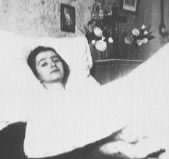
the walk up the hill to La Plaine to spend ten minutes in her darkened
room. All came away with a fresh vision of their place in the world.
Many priests had their vocations restored by meeting her. She counted famous philosophers among her friends. She carried on a considerable correspondence through secretaries (for she was unable to write herself), and was especially concerned for the welfare of the most deprived in society, such as prisoners and missionaries to whom she sent parcels of good things. "I
want to enlighten souls as did the Prophets and Doctors of the Church
... I should like to go all over the earth in every direction , and
preach the Holy Name of God, and plant in the ground the Glorious Cross
of our Lord Jesus Christ. But one mission would not be enough ... God
has given me the apostolate of Love in suffering." And in a very real sense this is what has happened. From the paralytic's couch in her little farmhouse, the influence of Marthe Robin has spread throughout the world, and is still spreading. Since her death a succession of books have been written, drawing on the incredibly rich legacy of sayings, prayers and poems carefully hoarded by Père Finet. We are now able to gauge the amazing richness of her spiritual life of suffering in union with Jesus, her Redeemer, and Mary, her Mother. Her
teaching is undoubtedly going to have a profound effect on the Church
of the Third Millennium, for which Pope John Paul II has been preparing
us. And it may be that, like the founder of another lay initiative Opus
Dei, she will reach the altars quite quickly. Martin Blake |